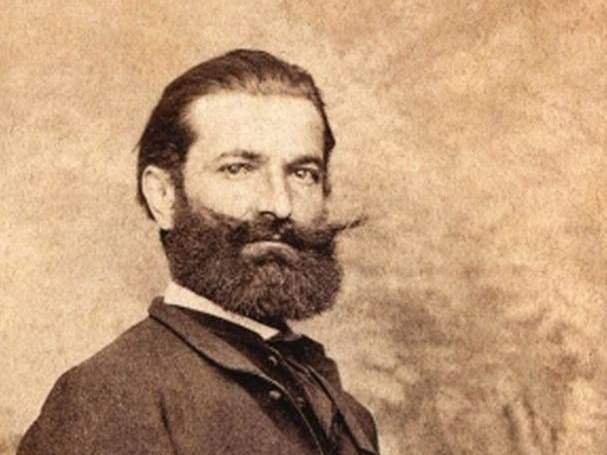
 Balázs Orbán was a writer, ethnographer, historian, traveler, photographer, and politician, widely regarded as one of the greatest figures of 19th-century Székely and Transylvanian cultural history. Through his extensive scholarly and literary work, he became one of the most important documentarians of Székely Land and its historical heritage.
Born in Lengyelfalva (today Polonița, Romania), Balázs Orbán came from an old Székely Unitarian family. In his youth, he traveled widely across the Middle East and Western Europe, experiences that broadened his intellectual horizons and deepened his interest in history, geography, and ethnography.
His life’s most significant achievement was the monumental six-volume work The Description of Székely Land from Historical, Archaeological, Natural History, and Ethnographical Perspectives (A Székelyföld leírása történelmi, régészeti, természetrajzi s népismei szempontból), published between 1868 and 1873. Combining rigorous historical research, ethnographic observation, folklore, and illustrations based on his own pioneering photographs, the work remains one of the most comprehensive records ever created about Székely Land and its communities.
Balázs Orbán devoted much of his life to documenting villages, churches, castles, traditions, and everyday life throughout Transylvania. His work preserved invaluable information about many sites and customs that later disappeared or changed significantly over time. Alongside his scholarly activity, he also served as a member of the Hungarian Parliament and actively supported education, cultural preservation, and public life.