
Table of Contents
GOD
In Unitarian theology, God is understood as an indivisible reality, both in essence and in person.
In our understanding, God is the one who created the universe and who sustains its existence at every moment. God is the inexpressible, spiritual foundation of all being, whose existence cannot be proven—and does not need to be. Since God’s essence is entirely beyond the grasp of the human mind, the religious soul in every age has sought to express the inexpressible through metaphors. These images are, by their very nature, products of human imagination, and therefore profoundly human. Thus, Holy Scripture, which forms the basis of Christian theology, speaks of God as a mighty Sovereign, a judge, or—as Jesus himself expressed it—a Father. These expressions aim to give form to a reality that cannot be fully explained, yet can be experienced, and which is also present within the human being. According to another metaphor, God is like an abundant spring from which every part of existence—great and small alike—comes into being. In this sense, God is the Creator of all, to whom the existence of the world is owed.
Yet God’s creation is not a one-time event that was completed at some distant moment in the past. In other words, God is not a cosmic watchmaker who, having finished this work, observes its operation from a distance without intervention. On the contrary, creation is an ongoing process that unfolds in every moment. God’s presence permeates all of creation and sustains its existence. This attentive presence is what we call providence, by which we mean that God cares for and watches over all creation. However, this does not occur through the suspension of the laws of nature, but through the extraordinarily complex processes that we call existence. The predictable order of cause and effect is what makes the world livable. A miracle that overrides natural laws would instead introduce chaotic unpredictability, rendering the universe subject to momentary change.

Although we can speak of God only through symbols, our faith affirms that God approaches humanity in love. By love, we primarily mean God’s movement toward the human being, as well as the human response to that divine approach. In other words, the term expresses a relational reality, imbued with emotional depth, pointing to the connection that is revealed in the encounter between God and humanity, God and the world, and between one human being and another. God’s love is manifested in a presence that is never intrusive, yet always near—giving strength and sanctifying life. On the part of the human being, it is expressed in an active response to this divine approach. If we were to describe this with another image, God is like sunlight that pours over everything, while the human being is like a sunflower that turns and follows the path of the light.
Since God is the very foundation of existence, God’s being cannot be proven. God alone stands beyond the bounds of existence, for even existence itself is God’s creation. Yet for the person of faith, the absence of logical proof or scientific evidence has never posed a real difficulty. Faith does not arise from proof; rather, it already presupposes the existence of the Creator. In this sense, faith precedes understanding, but once faith awakens, understanding is enriched with new depth. The human task is not to “solve” God—that is, to penetrate God’s essence and fully comprehend the divine—but to live in a relationship of love with God. To paraphrase Martin Buber: one cannot truly speak about God, only with God.
JESUS
Throughout the history of humanity, there have always been individuals who experienced and understood God’s truth, presence, and will more clearly and deeply than others.
According to our understanding, the most faithful teaching about God is found in Jesus of Nazareth, and through his life we may come to understand the path that leads to God. At the same time, we firmly believe that Jesus was entirely and exclusively human, just as we all are. His teaching can be most succinctly summarized in the twofold commandment of love, which reads:
“The most important one,” answered Jesus, “is this: ‘Hear, O Israel: The Lord our God, the Lord is one. Love the Lord your God with all your heart and with all your soul and with all your mind and with all your strength.’ The second is this: ‘Love your neighbor as yourself.’ There is no commandment greater than these.” (Mark 12:29–31)
This commandment expresses most clearly the relationship which, according to Jesus, ought to be realized between human beings and God, and among human beings themselves. It was in the spirit of this love that he lived and taught. Instead of external formalism, he located the essence of religion in inner experience. Rather than the exclusionary and restrictive attitudes shaped by social conventions, he proposed a way of seeing in which every person is recognized as a brother or sister. He exposed the misuse of status as an instrument of power and sought the human being in their created dignity. He did not seek God through elaborate rituals, but in the simplest form of prayer, and he taught his followers to encounter God in this same direct way.
It is therefore not surprising that—so often in human history—his candid search for truth and his exposure of falsehood provoked the anger of those in power. He was condemned on fabricated charges and put to death. After his crucifixion, his memory was at first preserved only by a small circle of his immediate followers. Yet the impact of his teaching proved so powerful that his disciples successfully spread his sayings and example both among Jewish communities and throughout the cities of the Mediterranean world. Through the encounter with Greek culture—in which the deification of great individuals was not uncommon—Jesus’ human figure gradually began to change, and more and more people came to regard him as a being endowed with supernatural power. This understanding was later elevated to the level of dogma through the decisions of the early Church councils, and the belief came to prevail that Jesus is the only-begotten Son of God, possessing two natures—fully human and fully divine—who rose bodily after his death and ascended into heaven. We, as Unitarians, cannot accept this interpretation. Instead, we regard the Master as a gifted and authentic messenger of God, who, like us, was fully human.
It is precisely this humanity that makes him a model we can follow, and his teaching and example a path, a truth, and a life.
HUMAN
According to the biblical account, God created the human being by forming a body from the dust of the ground and breathing into it His own spirit.
The symbolic meaning of this text is twofold: first, that the human being is God’s creation; and second, that humans differ from other creatures because, alongside their physical nature, they possess a divine spirit. The narrative continues by describing how the human being, created as male and female, gains identity—an awareness of their own existence—after eating from the tree of the knowledge of good and evil. The story suggests that before this, the human being differed little from other living beings; through this act, however, the human being became conscious of individual existence and thus truly distinct. What is traditionally understood as the Fall can therefore be understood, rather, as the emergence of human self-awareness, or as the continuation of creation itself.
With this in mind, we understand the human being as fully part of the biological world. Science has demonstrated the deep kinship between humans and other species, and recent findings suggest that certain emotions once thought to be uniquely human are also present in the animal kingdom. The distinctiveness of the human being is not found in biological composition, instincts, or primary emotions, but in a unique capacity for conscious experience: the ability to comprehend our own existence, to reflect upon ourselves, and to transform our lives through this process. In other words, the human being alone is capable of distinguishing between good and evil—of deciding whether their actions bring harm or joy to another. Furthermore, the human being is the only creature capable, through complex linguistic abilities, of creating a new and meaningful reality out of intangible elements such as words and concepts.
Through these fundamental capacities, the human being is endowed with abilities that distinguish the human being from other creatures. Unitarian theology refers to these as spiritual faculties given by God.
Faith
Through this uniquely human spiritual faculty, we perceive God’s presence in our own lives. Faith is not merely the acceptance of God’s existence; it goes far beyond that. It is primarily the experience of God’s nearness, or, as the 19th-century theologian Friedrich Schleiermacher expressed it, the “feeling of absolute dependence” on God. In this sense, dependence does not imply a puppet-like relationship, but rather the recognition that human existence is intrinsically grounded in the existence of God, and that our finite life finds fulfillment in the perfect and boundless being of the Father. Faith also includes an element of trust. Those who live in faith experience their relationship with God as one of trust: wherever they go and whatever may happen, the source of their being—who approaches them in love—is present and sustains them.
The Mind
By this faculty, we do not mean only rational functions, though these are certainly included. It is more accurate to understand the mind as the totality of human cognitive capacity, encompassing both intellectual and emotional dimensions. The activity of the mind is of central importance in Unitarian theology. For this reason, the ever-expanding horizon of scientific discovery serves as a vital source for humanity, shaping religious thought and helping us understand the meaning of our existence more clearly. Unitarian faith sees no contradiction between reason and faith; on the contrary, it views them as complementary. Faith without reason can easily lead to fanaticism or superstition, while reason without faith may lose its deeper purpose and become an amoral servant of immediate interests (as seen in the horrors of the Second World War, where mass destruction was carried out through precise, scientific methods). Symbolically, faith points toward the horizon, encouraging the mind to move toward insights not yet fully seen, but already sensed.
Free Will
The human being is created as a free being, capable of choosing between good and evil. Clearly, this freedom does not override the constraints of nature: we cannot, by will alone, fly or exist in two places at once. Free will pertains to moral choice, and in this respect, we believe the human being decides independently. If this were not so, our existence would be a predetermined script in which the individual has no role. Such a view would contradict the idea of a loving God and render the notion of justice meaningless. For where there is no freedom, there can be no responsibility—only inevitability.
Conscience
The complementary counterpart to free will is conscience, which gives direction and form to the will. Nearly every culture has known the “Golden Rule”: that one should not do to others what one would not wish done to oneself. This principle is an expression of conscience, which restrains and guides free will, reminding us that freedom is inseparable from responsibility. In Unitarian theology, this responsibility is not rooted in fear of external judgment, but in the inner working of conscience. When we act rightly, our conscience is at peace; when we do wrong, it reproaches us. Like all human faculties, conscience can atrophy if neglected, but such a state is akin to illness; it is the responsibility of each person to preserve both their physical and spiritual well-being.

Love
The most fundamental spiritual faculty is love. It is the core experience that must shape human relationships in every circumstance. A loving attentiveness toward the world, our fellow human beings, and God is the essential condition for a full human life.
Unitarian theology understands the human being as an indivisible unity. We do not divide the individual into two separate substances—body and soul. Our physical life is inseparably intertwined and in constant interaction with our spiritual life. Therefore, the fullness of human existence requires care for both.
The purpose of human life remains a mystery that humanity has sought to unveil in every age. As Unitarians, recognizing our human limitations, we hold that life itself is a value and that each moment should be lived fully. Every moment of this transient life is an unrepeatable opportunity to gain wisdom, to learn, and to act.
HOLY SCRIPTURE
The foundational text of the Christian Unitarian faith is the Bible.
This collection, spanning several millennia, is composed of texts that differ widely in authorship, period, language, genre, and content, yet holds enduring significance. Unitarian theology stands firmly on a biblical foundation, even as it adheres not to the letter of the text, but to its spirit. We recognize that the social conditions in which the books of Scripture were written, as well as the human limitations inherent in every age, are reflected in certain narratives. Yet the overarching spirit of the Bible remains life-affirming and true.
For this reason, the Bible must be read and interpreted with the help of reason. Holy Scripture serves as a point of reference—not to prove or disprove the literal truth of its contents, but to discover the meaning that lies behind the words. When approached in this way, the possibilities for interpretation become limitless, allowing each person—regardless of culture or historical context—to find wisdom that serves as guidance. At the same time, this approach enables a holistic interpretation of Scripture. A given biblical passage does not have a single, definitive meaning; rather, it offers a range of possible interpretations that unfold most fully when the reader approaches the text again with an open mind.
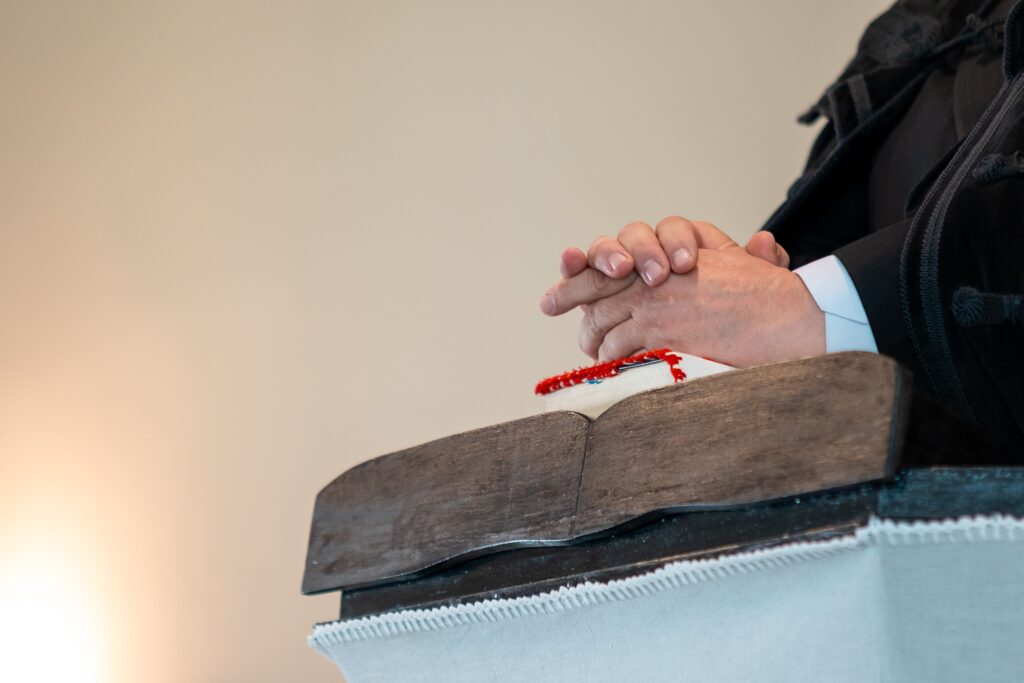
According to our understanding, the Bible is divinely inspired. However, this does not imply a mechanical process of dictation. Instead, it means that each author expressed, to the best of their ability and within the context of their time, what they entrusted to future generations.
The Bible primarily invites us into a dialogue. While we acknowledge that understanding the historical context—revealed through scholarly methods—is essential for a fuller interpretation, its relevance lies in how it speaks to the present. One may question, disagree with, or even argue against the words of Scripture; yet in all such engagement, it is essential to remember that the purpose of reading and reflection is to improve the quality of one’s own life through deeper understanding.
A way of thinking rooted in Scripture, yet complemented by thoughtful interpretation, offers a life-affirming path that brings the believer closer to God.
SIN AND FORGIVENESS
One of the most fundamental questions of religion concerns sin and the way in which one may be cleansed from it. Within Christianity, sin is most commonly understood as a turning away from the will or law of God.
Sin, therefore, is any action—or omission—that denies the divine will. This leads naturally to the question of evil. It is a universal human experience that evil exists in the world and manifests itself in human life as sin. One of the central tasks of religion has always been to identify the source of evil and to offer means by which human beings may confront it. This approach has often led to the idea of a metaphysical opposition between good and evil. Throughout history, many have believed—and still believe—that alongside the perfectly good God there exists an entirely evil counterpart, a conscious and powerful being whose role is to sow the seeds of sin within the human soul. Christianity traditionally refers to this figure as Satan or the Devil.
Unitarian theology, however, does not affirm the actual existence of the Devil or of any inherently evil substance. In our understanding, the personification of evil is symbolic—it expresses the human experience of evil. We believe that the source of moral evil lies in human frailty. Human beings are given one life in which to refine and ennoble their own nature. Alongside our virtues, our consciousness also contains weaknesses, which we collectively call frailty. It is through fear, envy, resentment, greed, or other such weaknesses that people harm one another. From this arises the moral evil we encounter in the world, and such actions are what we call sin. This also means that responsibility for evil rests entirely with the individual: no one can claim to have acted under the influence of a greater external force. Each person is accountable for the suffering they cause in the world.
Unitarian theology distinguishes between two forms of sin: sins of commission and sins of omission. It is a sin both to do what is wrong and to fail to do what is right.

Since we are all beings in constant development, it is difficult to imagine a person who has never committed sin. This universal fallibility may lead some to project their own weakness onto a conscious metaphysical being. In reality, it is simply that the frailty of the human soul often leads to morally blameworthy actions.
Yet, through God’s love, there is a remedy for sin: forgiveness. This is granted by God alone. No ritual and no person can claim the power to forgive another’s sins. Forgiveness belongs to God alone, yet there is a clear path through which it is received.
First, the conscience must awaken within the person who has sinned. A troubled, accusing conscience weighs upon the individual, and gradually the feeling of remorse emerges. Repentance is often a long and painful process, one that may last for years or even a lifetime. The awareness of one’s wrongdoing gives rise to feelings of shame and sorrow. In this struggle, the believer turns to God in prayer and experiences the presence of the Creator. In time, the individual comes to experience the forgiveness of God, often felt as a deep sense of peace.
At the same time, it must be recognized that, like the scar left by a healed wound, the mark of sin remains as a reminder on the soul.
One of the aims of human life, therefore, is to refine oneself to the point where one can make decisions in every situation that can be accounted for before one’s own conscience.
DEATH AND ETERNAL LIFE
Mortality is an inherent feature of human existence. Whether we are conscious of it or not, death inevitably separates us from our earthly life.
In every age, human beings have asked questions about the meaning of death and the possibility and nature of life beyond it. Various religious traditions, shaped by their own cultural contexts, have sought to answer these fundamental questions. In Unitarian faith, death is understood as a necessary departure—one that should not be feared, though it should not be recklessly sought either.
At the same time, the finitude of human life gives it its value. Since each of us has only a limited amount of time on this earth, it is our responsibility to fill that time with meaning. We also affirm that death does not signify the end of human existence, but rather a threshold that we must inevitably cross. In our understanding, it would not be consistent with God’s parental love for the human being simply to cease to exist. At the same time, Unitarian theology firmly refrains from speculating about the exact nature of existence beyond death. We believe that what follows death is a mystery beyond human comprehension, and that its investigation cannot offer meaningful answers for the living.

We do not seek to engage in debates about the nature of judgment after death. Instead, we consider it more truthful to acknowledge the limits of our human understanding and to refrain from such speculation. If God has chosen not to reveal this mystery to us in our earthly life, then we accept this with trust, as children of God. Rather than pursuing answers that remain beyond our reach, we turn our attention to this life and this world. There is more than enough to learn, discover, and resolve here, without attempting—within our human limitations—to tear away the symbolic veil that surrounds what lies beyond.
In this respect, the Unitarian believer seeks the guiding hand of our Father, trusting to be led as God sees fit. At the same time, we hold with deep trust that our Father continues our existence beyond this life in a manner that is good in His sight. We do not seek to resolve the question of whether the so-called soul survives the body—whether consciousness continues without material form, freed from the constraints of space and time. We believe it is more fitting to acknowledge the limits of our understanding and to place our trust in God.
Otherwise, ideas formed by human imagination may quickly take on the appearance of reality, though they are neither reliable nor helpful. At the same time, we accept that others may believe they know what happens after death, and we respectfully ask that the same tolerance be extended toward our own understanding.
WORSHIP
The human being is inherently religious. We express our intuitions about God through symbols. Among these are worship services and rituals, which we do not perform to appease God, but so that we ourselves may come to a deeper understanding. In other words, it is not God who needs prayer, but we who need it.
The foundation of Unitarian worship is prayer. Prayer is the conscious attunement of the human soul to divine reality. It may take as many forms as there are feelings within the human heart: it may be a plea, an expression of gratitude, repentance, or joy. Its essence, however, is the sincere opening of oneself before God. Prayer does not exist only in words; therefore, elaborate or carefully crafted language is not required. It is equally genuine when a person pours out their soul before the Creator in silence. What matters is the awareness of prayer. We should participate in it with our whole being, bringing our thoughts and feelings to the surface of our consciousness. It is also important to note that, in our understanding, those who regard prayer as a kind of miracle-working tool are mistaken. Those who expect their requests to be fulfilled directly by God, and become disappointed when they are not, misunderstand its nature. God is not a granter of wishes, but the one who gives strength so that what truly matters may be accomplished through our own efforts.
Because of the importance of conscious presence, mechanically recited, fixed texts do not constitute true prayer. At the same time, the regular practice of prayer on a daily basis helps to improve the quality of life.
In certain settings, prayer takes on a more structured form, which we call corporate worship. Unitarian worship follows the traditions of Protestant simplicity. At its center stands the prayer of the congregation, but a prominent role is also given to the sermon delivered by the minister. This sermon, typically lasting 20–25 minutes, is always inspired by Scripture, meaning that the minister interprets a selected biblical passage according to their knowledge and insight, with the aim of encouraging reflection and strengthening faith. The thoughts expressed in the sermon, however, are not identical with the statements of Scripture and are not to be regarded as absolute truths; rather, their purpose is to invite the congregation into dialogue.
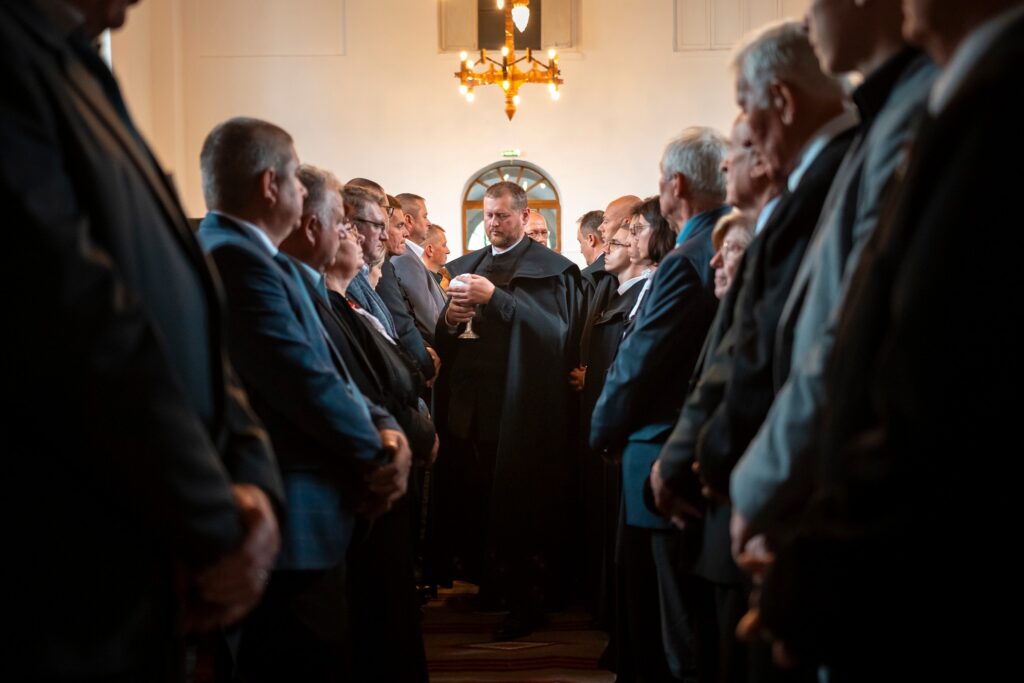
Unitarians gather for worship every Sunday, though services may be held on other days as well. These occasions do not have an automatic or mechanical effect on the soul. Mere presence does not in itself bring spiritual strengthening or purification; this depends on the attitude of the individual.
In addition to Sunday, the most common day of worship, Unitarians follow the Christian liturgical calendar. Our major celebrations include Christmas, Palm Sunday, Easter, Ascension Day, Pentecost, and the autumn Thanksgiving. We also commemorate January 13, the Day of Religious Freedom, and on November 15 we honor the memory of our founding bishop, Ferenc Dávid. At the same time, many local celebrations are observed within our congregations. In our understanding, a true feast is not only marked by the calendar; any day becomes a celebration if it brings us closer to God or calls our attention to a higher truth.
The life of a Unitarian is accompanied by rites of passage. Infants are usually baptized at the request of their parents. This ceremony is understood as a symbolic act of incorporation into the Church. Although the focus is on the child, the active participants are the parents and godparents, who commit themselves to raising the child according to Christian values. Baptism does not remove sin, as Unitarians do not accept the doctrine of original sin. Furthermore, baptism is primarily a Christian act and only secondarily a denominational one. For this reason, it is a once-in-a-lifetime event and is not repeated, even if a person changes denomination.
As the child grows, at around the age of fourteen, they publicly affirm their faith before the congregation. This rite is called confirmation, through which the young person becomes a full member of the congregation. As a sign of this, they partake in Holy Communion for the first time, commemorating the life, teaching, and death of Jesus.
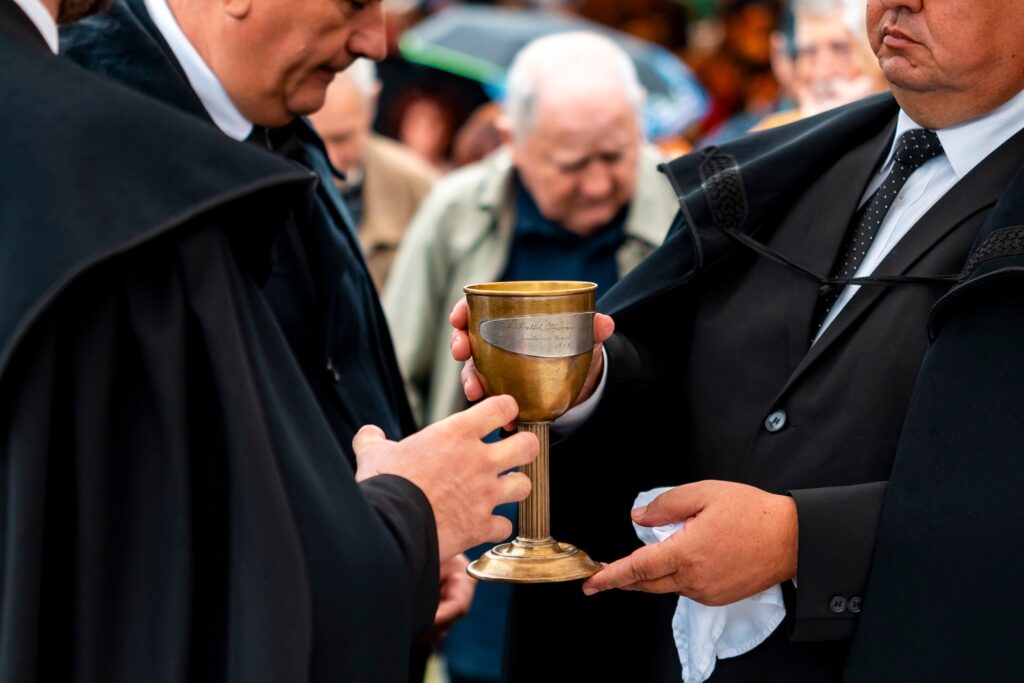
Holy Communion, a rite that can be traced directly back to Jesus, is the most intimate moment of Unitarian worship. We celebrate it four times a year—at Christmas, Easter, Pentecost, and the autumn Thanksgiving—using bread and wine. Communion is the ritual expression of Jesus’ open table fellowship. Because of its inclusive nature, no one should be excluded from it, except those who cannot distinguish between the sacred moment and ordinary eating and drinking. Communion does not have the power to erase sin or to secure salvation in itself; rather, it is an occasion for remembrance and spiritual strengthening, the depth of which depends on the individual.
Unitarian couples pledge lifelong fidelity to one another within the context of a worship service. We accompany our departed brothers and sisters on their final journey through funeral rites.
The essence of these rites does not lie in external form. Their true purpose is to help the individual reflect upon and renew their inner life.