
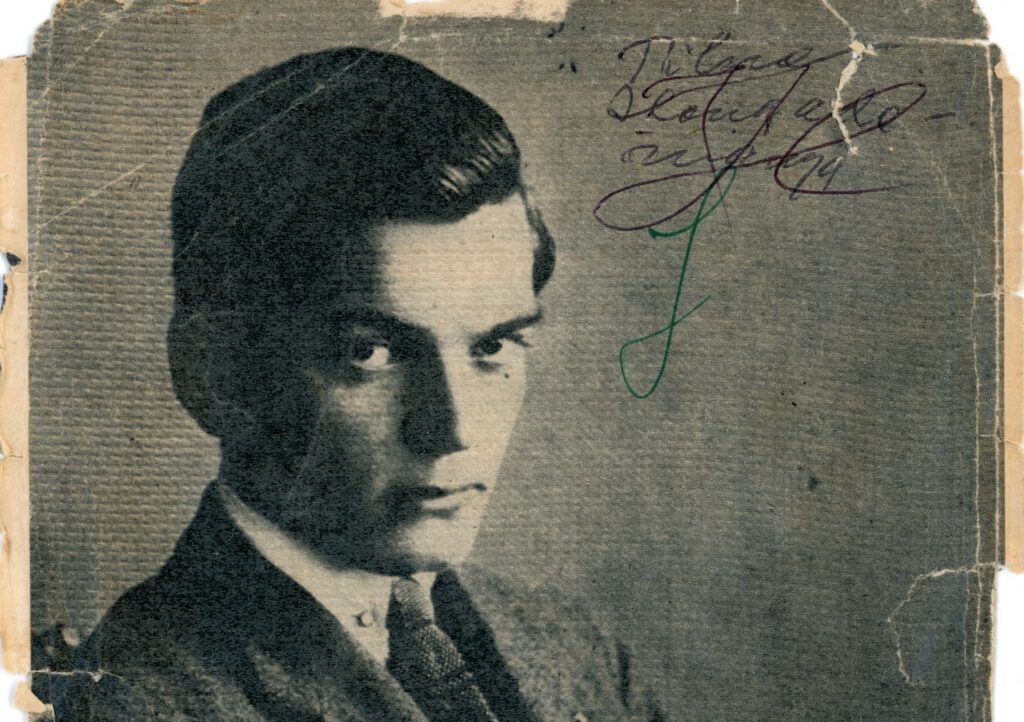
Compiled by: Tímea Berki
The Writer’s Role in the Life of Ferenc Balázs
In this commemorative year, the life’s work of Ferenc Balázs is presented from eleven perspectives, and inevitably his literary roles recall the 1923 anthology The Eleven, the first collective appearance of a group of writers after 1918. Alongside Ferenc Balázs, István Dobai, Zoltán Finta, Géza Jakab, Béla Jancsó, Sándor Kacsó, János Kemény, Albert Maksay, László Mihály, Sándor Szent-Iványi, and Áron Tamási participated in this undertaking, whose significance is undeniable both in Transylvanian and overall Hungarian literary history.
In 1938, László Cs. Szabó claimed of these young authors—most of whom debuted through the anthology—that “literature was a transition between the Transylvanian school bench and their minority vocation in life,” and that only Áron Tamási became “exclusively a creative writer.” Nevertheless, examining Ferenc Balázs’s literary role is far from irrelevant. His serialized tales and travelogue (I Travel the Round World) fit into the Hungarian literary tradition shaped by periodical culture, while in book form they became part of innovative initiatives such as the children’s magazine Cimbora and its book series, as well as the publishing house of the Helikon writers’ community, the Transylvanian Fine Arts Guild.
His novel Green Flood and his memoir Under the Soil were written during the worsening of his illness, in a period when he was forced to withdraw from his physically demanding initiatives and his projects in Mészkő and the Aranyos region. These circumstances both hindered the full unfolding of his literary career and served as sources of inspiration for his written and planned works.
[“In the past five years, have I had the opportunity to present myself to the world with any serious literary work? And yet I have developed plans for at least eight books, among which it was a pity to delay even until now the most important: the exposition of my religious worldview; for I have exposed myself to the slander that I have none. Now perhaps two or three of these books will become reality. And I can read. Only the first two or three months are difficult, while even lifting a book is a burden. But afterward!”]
In Under the Soil, he reflects on the tension he perceives between writing and action:
“I have long wanted it, and others urge me: I can no longer avoid writing. Yet it is a sacrifice to others’ wishes, or to my own vanity. I steal hours from my life to give a copy of the real life of earlier hours. I have shortened my life. Even now, as I sit by the window writing these lines, I could be out in the stable…”
Similarly, in his poetry he meditates on the relationship between writing and life, the time invested and taken from elsewhere, creation and action. His literary oeuvre and its reception are thus organically embedded in the history of twentieth-century Transylvanian Hungarian literature.
Historical Context
Approaching the end of his Unitarian theological studies in his twenties, after self-education circle activities and numerous publications in journals (Cimbora, Keleti Újság), Ferenc Balázs had already become an author with a volume by 1923.
[His Stream of Tales, published in installments in Cimbora in 1922, appeared the same year in Szatmár as the third volume of the Cimbora Library. This collection of tales—exciting for adults as well, framed in structure, combining folk tale with myth-making ambition and written in a Secessionist style—was republished a hundred years later, in 2022 in Cluj-Napoca, illustrated by artist Andrea Jánosi, on the occasion of the 450th anniversary of our church.]
His programmatic introduction to The Eleven anthology already contains in germ all the ideas he would later pursue, driven by a general need for cultural and literary self-organization. In his argument, the emerging generation of writers recognizes the Transylvanian, the regional, as something distinctive even from the perspective of universality and the broader Hungarian literature.
[“Hungarian land was divided into parts, and the head—Budapest—was cut off from the arms and legs. […] Until now, all value produced in the regions flowed into Budapest […]. At the great farewell, it was not yet known whether anything would flow back to the orphaned territories, or whether a new corps of writers would arise among the mountains. But now Transylvanian Hungarian literature, with a new head and new limbs, undeniably and beyond dispute: exists.”]
He encouraged the discovery of the Székely folk spirit that inspires the idea of regionality, linking the folk with avant-garde European modernity—similarly to Béla Bartók, who drew inspiration from the “pure source.”
Although the publishing plan outlined in the program failed for The Eleven, the subscription system proposed by Balázs later contributed to the success of the Transylvanian Fine Arts Guild’s publishing policy. The voluntary assumption of service and task-oriented thinking would later reappear in cooperative and folk high school movements. The establishment of the genre of Transylvanian literary sociography is also due to his work Under the Soil.
Early Transylvanism, as consolation, sustaining force, and identity-building impulse, encouraged action, and Balázs—at the forefront of the populist movement—realized this in practice, in contrast to the historical (Károly Kós) and messianic (Sándor Makkai) conceptions. In the universal he sought the local, in the diversity of the world the particular in I Travel the Round World; he summarized the experiences and failures of community life and village development in Under the Soil [“My true journey began when I shook off the dust of world travel and set out to struggle with my fate, to create my life”] and in the novel Green Flood, which, like his tale collection edited by Márta Kuti in 1973, does not lack lyricism.
Examples of His Literary Practice
Even during his travels abroad, Balázs remained connected to Transylvania. In 1928, he published his travel experiences in Keleti Újság in the form of personal reports, aiming to inform and acquaint readers. The newspaper referred to him as a “world-traveling Székely theologian,” acknowledged his merits among young Transylvanian writers, and announced that he would write a book about his journey.
It also promoted as a special event that the keen observer and excellent writer would give a lecture on September 22, 1928, at the Journalists’ Club, preceded by a presentation at the Unitarian College, where he would also sing Eastern folk songs. The paper then undertook to publish his travel diary in installments. These examples demonstrate both the distinguished attention directed at Balázs and the functioning of literature in a broader sense at the turn of the century.
The story of the creation and reception of I Travel the Round World—a first-person narrative—emerges from this context. In his reports, Balázs already reflects on the experience of traveling across continents. It is clear that he intended his work for a wider readership: his personal story transcends the individual and becomes communal, while maintaining the appearance of subjectivity. The serialized publication, alongside oral storytelling in lectures, shows his intention to create a refined, lasting text beyond ephemeral genres such as journalism and public speaking.
Thus, the young writer who began as a storyteller and poet consciously assumes authorship within Hungarian literature. His style embraces both narrative elements reminiscent of fairy tales and lyrical insertions, even in book form. Under the Soil continues this trajectory, and it is no coincidence that it was published in Torda by the Aranyosszék Rural Development Cooperative through subscriptions.
The Literary Legacy of Ferenc Balázs Today
The themes of Balázs’s three major prose works (I Travel the Round World, Under the Soil, Green Flood) still raise relevant questions today, such as the contrast between the nature- and tradition-oriented village and the city lacking communal experience, or the misunderstood position of the intellectual and the successes and failures of his roles.
The use of first-person narration in the first two works and the identity constructions it creates shape the image of a strongly mission-driven intellectual, which reception has often equated with Balázs himself, overlooking the literary qualities of these strongly sociographic texts. Unfortunately, Green Flood has also often been interpreted primarily from this perspective, neglecting its literary merits. Even Imre Mikó read it as a key novel, attempting to identify real-life counterparts of its locations and characters, as Vilmos Keszeg pointed out in a 2022 study.
Interestingly, Keszeg himself later attempted a re-reading of the novel by considering the context of folk culture, which is intrinsic to the text as a representation of the Aranyos region. At the same time, the concept of nation emerging in these texts can place Balázs’s prose in a new light from the perspective of transnational literary interpretation. The lyricism and Secessionist style of his poems and tales also deserve comparison with similar works by contemporary authors.
From the perspective of so-called “sensitivity literature,” his tales written for children are also noteworthy, while his stories for adults, with their reflective and philosophical nature, offer excellent exercises in attention for readers seeking slowness and inward reflection.
Bibliography
Primary Works
Ferenc Balázs: Stream of Tales, Szatmár, 1922.
Ferenc Balázs: I Travel the Round World, 1923–1928, Cluj–Kolozsvár, 1929.
Ferenc Balázs: Under the Soil, Torda, 1936.
Ferenc Balázs: Green Flood, Cluj-Napoca, 1936; Budapest, 1937.
Ferenc Balázs: Tales, Bucharest, 1973.
Ferenc Balázs: The Flame of the Eternal Lamp Emits No Smoke. Selected Poems, edited by Éva Farkas Wellmann, Budapest, 2019.
Secondary Literature
László Boka (ed.): Transylvanism. Ideas, Periods, Variants, Budapest, 2023.
Péter Cseke (ed.): Time Spoke Through Them. The Eleven a Hundred Years Later, Cluj-Napoca, 2025.
Vilmos Keszeg: “Ferenc Balázs in Memory,” in Entering Memory, Cluj-Napoca, 2022.
Imre Mikó, Antal Kicsi, István Sz. Horváth: Ferenc Balázs. Monograph, Bucharest, 1983.
Béla Balázs Végh: “In the Enchantment of the Tale. The Tales of Ferenc Balázs,” Művelődés, 2005/10.