
Compiled by: Róbert Zoltán Bálint
“I am a pastor: a little bit a priest, but more a prophet.”
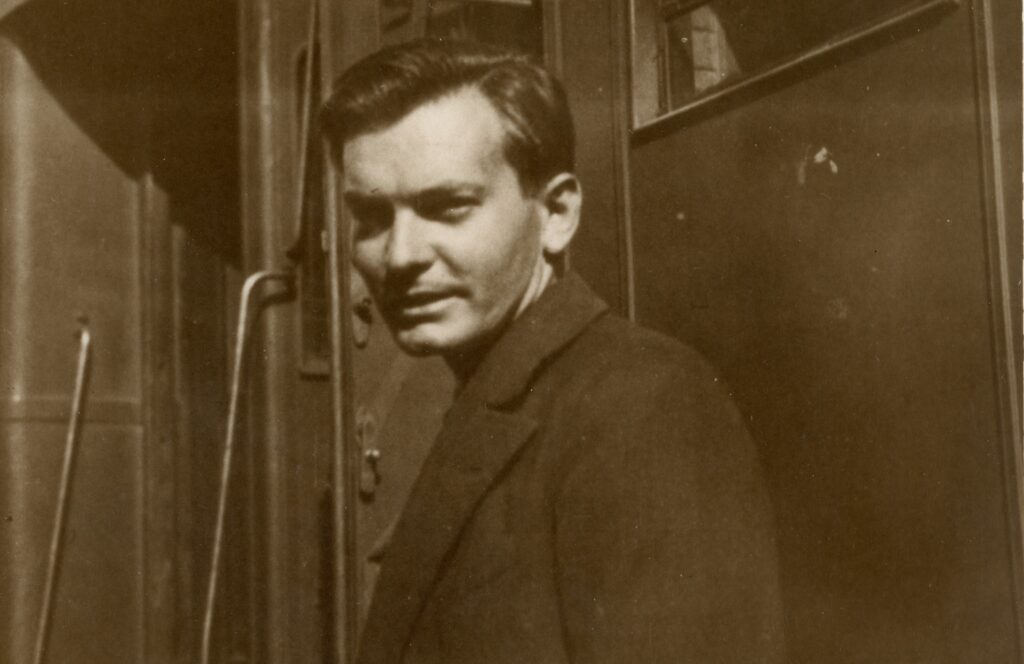
Ferenc Balázs, the “apostle of Mészkő,” is regarded as one of the defining figures of Hungarian minority life in Transylvania in the 1930s. Although his life’s work is multifaceted, one of the main points of reference is his pastoral vocation – yet this role he fundamentally reinterpreted. For him, the ministry was an active, community-shaping presence: “I saw my vocation clearly; for me, the pastoral career and church work meant an opportunity to transform the social and economic life of the village,” he wrote in his autobiographical work Under the Clad.
After returning from his five year study trip from the United Kingdom, United States of America and the Far East, he was eager to immerse himself immediately in pastoral work, but had to wait a year and a half. The setting of his ministry became Mészkő in Aranyosszék, where he arrived in 1930 with his American fiancée, Christine. He saw the village as an ideal field for realizing his ideas: “The pastoral position in Mészkő does not boast of material wealth, but the village is a cross-section of Transylvania. (…) Here is everything that is Transylvania: mountains, plains, landslides, rocks, fissures, a river, a mine, and nearby the small town improved (or worsened) by factories: Torda. (…) Hungarians, Romanians live here; farmers, craftsmen, merchants, factory workers, miners, gentlemen. What a joy it will be to drink deeply of the essence of Transylvanian life.” (Under the Clad).
What emerges is a socially stratified and ethnically diverse rural world, where the advance of industrialization gradually weakens the peasant-farmer class, and the traditional agrarian society begins to disintegrate, while processes of modernization become increasingly pronounced. Into this transforming environment – full of internal tensions and new opportunities – arrives Ferenc Balázs, who consciously distances himself from the traditional clerical role. As an educator of the people and a “village apostle,” he builds on personal connection. He believes that questions of faith must be brought out from within the walls of the church into the “sunlight,” and turned into a driving force of community progress.
He fundamentally interprets his service as a prophetic mission, which does not limit itself to teaching and guidance, but also entails active intervention:
“I am a worker of the Kingdom of God, and the Kingdom of God is life. Within the four walls of the church we may at most win souls: inspiration, direction. I must lead my people in every turn of their lives toward divine heights. I must intervene in their farming, their spending, their building, their clothing, their use of free time. Beauty, love, understanding, and justice must not only be preached, but realized within the limits of possibility. And because I am primarily a prophet, I can only be a priest in the way that my prophetic calling allows.”
His work vividly exemplifies the commitment of the Hungarian minority intelligentsia in Transylvania to social responsibility and service to the community.
This sense of responsibility is evident in all areas of his activity; here we mention only a few examples related to congregational life: he preserved the medieval church for posterity, which the congregation had intended to replace with a new, “modern” one; opposing indifference, he had the denominational school building expanded so that some Hungarian children would not be forced to continue their studies in Romanian-language schools. The organization of church-social groups—women’s association, youth—as well as the introduction of new types of communal religious gatherings all served the spiritual strengthening and renewal of the community.
“Never, nowhere, on any other occasion did people leave a hall so refreshed, with such smiling serenity, so awakened to new life, as at the end of these religious evenings, held every winter ever since. They lit their little lamps to find their way home; their souls were already aflame; the departing multitude was a shimmering stream which, joyful and grateful, surrounded me and flowed past me.”
However, this innovative, prophetic attitude also brought tensions. He consciously accepted this: “Let me remain a pastor, a fusion of priest and prophet. Pastoral work is hard labor, a bitter bread. Let him be himself, a servant of man, a man of God; let people follow him and love him—that is the vocation of the pastor. Knowing this, I have no cause for complaint. Anger is due to the prophet, love to the priest. I receive both abundantly.”
Reflecting on his ministry, he said:
“The past five years of my pastoral work have been exciting. Perhaps no one else felt it, only I, but the air was tense. The storm could have broken out at any moment; only a spark of electricity was missing, which a careless word could have struck. Every Unitarian pastor lives, more or less, in such an atmosphere.”
In 1936, due to worsening tuberculosis, he was forced to resign his office; after his death in 1937, he was laid to rest in the cemetery of Mészkő. His memory is preserved by a carved wooden grave marker bearing the inscription: Ferenc Balázs, 1901–1937, priest.
The church, renovated in 1931 based on the plans of László Debreczeni, remains a place of pilgrimage to this day. Part of Balázs’s material legacy is also the parsonage designed by Debreczeni, which incorporates Hungarian, Danish, and Romanian architectural elements. Even more significant, however, is his intellectual legacy, which continues to serve as a source of renewal for the small Unitarian community of Mészkő.
Ferenc Balázs’s pastoral credo has not faded over the decades: amid the social and identity struggles of Transylvanian communities, it still speaks to us today. His life’s work stands as a reminder that a pastor must also be present as a community-building force and a creator of values in everyday life within the congregation. It teaches that the prophetic word cannot be separated from the courageous acceptance of conflict—this is an unavoidable part of sacrifice made for the community.
Bibliography
Ferenc Balázs: Under the Soil, published by the Aranyosszék Rural Development Cooperative, Torda, 1936.
Imre Mikó, Antal Kicsi, István Sz. Horváth: Ferenc Balázs. Monograph, Bucharest, Kriterion, 1983.
György Andrási: Ferenc Balázs, the Preacher of Mészkő.
Róbert Zoltán Bálint: “A Grave Marker for the Future – The Memory of Ferenc Balázs in Mészkő.” In Unitarian Calendar, Hungarian Unitarian Church, 2022.