
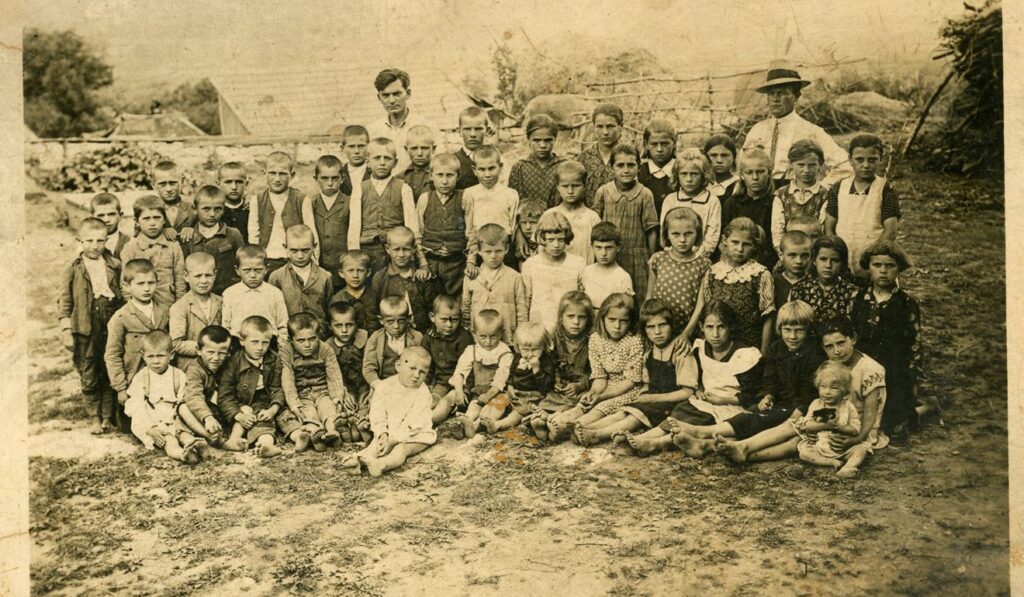
Compiled by: Zita Emese Magyari
At the center of Ferenc Balázs’s work as a youth organizer and educator stood the formation of the younger generation toward education, community responsibility, and active social engagement. He was convinced that the future of communities is fundamentally shaped by the intellectual and moral education young people receive. He defined this goal as: “to enable the child, through the creation of inner unity, harmony, and self-discipline, to devote all their strength to the realization of their goals.”¹
A key element of his educational approach was a focus on the individual. He believed that, in each case, one must find the unique path that leads a child to inner discipline². Speaking about youth organization—especially in connection with the youth association of Mészkő—he emphasized that the role of the pastor is to awaken and inspire. Of the Mészkő youth association he said: it has its own soul, “I did not breathe it into it; at most I grasped it, shook it awake, made the youth receptive so that it might become aware and awaken.”³
After returning from his “journey around the world”⁴, the church authorities appointed him as an educator in the boarding school of the gymnasium in Székelykeresztúr. Although he had originally longed for a rural pastoral ministry, he accepted the position and began to consciously develop his ideas on youth organization and education—ideas that were ahead of his time. His experiences, however, led him to critical reflections: he considered the school system overly rigid and restrictive to personality development. He described it as often functioning like an “intellectual straitjacket”⁵ that does not foster but rather hinders free development. In contrast, he sought forms of education that go beyond the framework of formal schooling.
He considered the establishment of folk high schools and evening courses essential, as these could serve the education of broader social groups. Freedom stood at the center of his educational philosophy: he believed that human beings naturally strive for development if given the proper space:
“Ask him kindly, gently, like a father; he will still eat, because he is hungry. The bird will escape from the cage even if its kindly speaking keeper leaves the door open. It longs for freedom.”⁶
He implemented this approach in practice as well. He provided opportunities for young people to develop according to their interests and talents, for example in various community and cultural activities:
“Anyone could become whatever they felt inclination and talent for. If they did not strike false notes, or not conspicuously, they could even be the double bassist of the Philharmonic Society.”⁷
His activity as a youth organizer was also significant in the field of popular education. He traveled through villages with a projection machine, accompanied by young people, to convey knowledge and new perspectives. Between 1929 and 1930, he gave illustrated lectures in one hundred villages, and the funds collected from these events were used to publish the first issues of the youth journal Kévekötés⁸. The aim of the journal was to spread knowledge, to educate thoughtful and active young people, and to extend the youth movement to every settlement.
He soon realized that the transmission of knowledge through visual presentations alone was not sufficient; the true goal was to awaken an inner desire for learning and creativity:
“The projection machines radiated knowledge and information. They broadened people’s horizons (…) But this is not enough. The sleeping spirit, the spirit that longs for more, must be awakened in people… Let their eyes open, so they may see that life is beautiful, delightful for those who create, dazzling and wondrous in human cooperation.”⁹
To this end, he organized winter gatherings (courses) and community events (Youth Days) for rural youth. He also actively participated in organizing the annual Unitarian Youth Conferences, held since 1928¹⁰, which played an important role in the communal life of young people.
Regarding youth education, he held that it can only be complete if, alongside intellectual development, space is given for emotional and communal expression as well. As he put it:
“Education of youth is only complete if, alongside preparation for a more intelligent life, the young person may sing themselves out, dance themselves out, play themselves out.”¹¹
In this spirit, he placed great emphasis on communal experiences and cultural activities, and considered theater an important tool of education.
In summary, the essence of Ferenc Balázs’s youth organizing and educational method lies in community experience—rooted in the folk high school movement—as well as in intellectual and religious development grounded in self-knowledge. His work had a significant impact on the youth movement of the Unitarian Church, and it still offers an example today of how youth organization and education can be meaningfully realized: discovering paths, treading them together into trails, for “it will become a road—you can already see it.”¹²
Bibliography
Ferenc Balázs: Under the Soil. Püski, Budapest, 1948.
Imre Mikó – Antal Kicsi – István Sz. Horváth: Ferenc Balázs. Monograph. Kriterion, Bucharest, 1983.
Dávid Gyerő: Kévekötők. Charta Publishing, Sfântu Gheorghe, 2000.
Kévekötés (youth journal)