
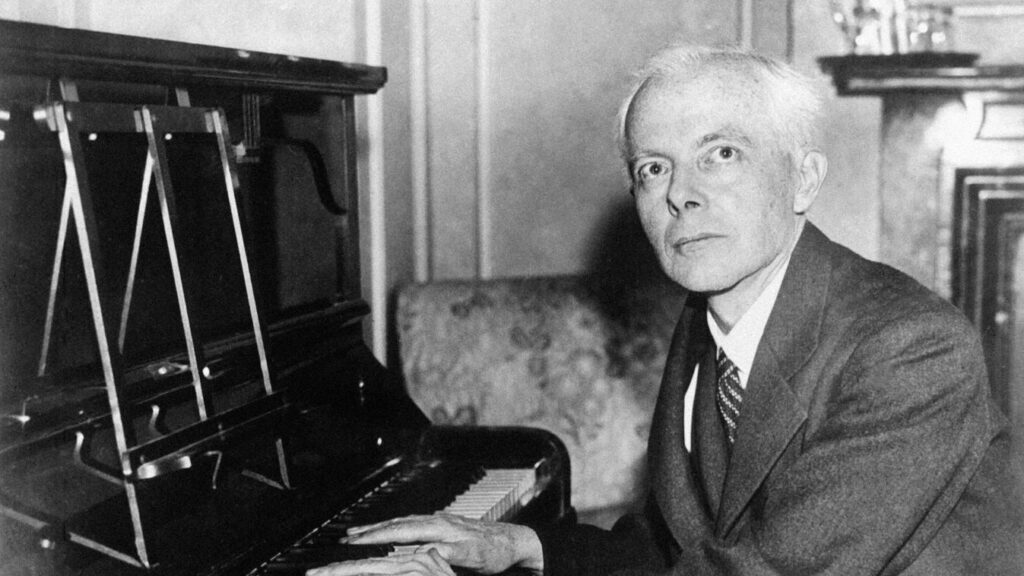
 Béla Bartók was one of the most influential composers and ethnomusicologists of the 20th century, whose work profoundly shaped modern classical music and the scientific study of folk traditions. Combining groundbreaking musical innovation with rigorous field research, he became a defining figure of Hungarian, Central European, and global cultural history.
Born in Nagyszentmiklós (today Sânnicolau Mare, Romania), Bartók studied at the Royal Academy of Music in Budapest, where he later became a distinguished professor. Early in his career, he turned away from late-Romantic musical traditions and began searching for a more authentic musical expression rooted in the folk traditions of Central and Eastern Europe.
Together with close colleague and fellow composer Zoltán Kodály, Bartók carried out extensive folk music collecting expeditions across Hungary, Transylvania, Romania, Slovakia, and the Balkans, later extending his research as far as Algeria and Turkey. Using early phonograph recordings, he documented thousands of peasant melodies, preserving an invaluable oral heritage from rural communities that were on the brink of modernization. His rigorous comparative methodology laid important foundations for the modern discipline of ethnomusicology.
Bartók’s compositions synthesized elements of Hungarian, Romanian, Slovak, and other folk traditions with innovative harmonic, modal, and rhythmic structures, creating a deeply original musical language. Among his best-known works are the Concerto for Orchestra, Music for Strings, Percussion and Celesta, and the opera Duke Bluebeard’s Castle.
Bartók’s legacy is also connected to Unitarian history. In 1916, he formally joined the Unitarian Church in Budapest, a decision often associated with his appreciation for intellectual freedom and independent thought. His connection to the denomination continued through his family: his son, Béla Bartók Jr., later served for many years as Lay President (főgondnok) of the Hungarian Unitarian Church and played an important role in supporting the institution during difficult historical periods.