 Introduction
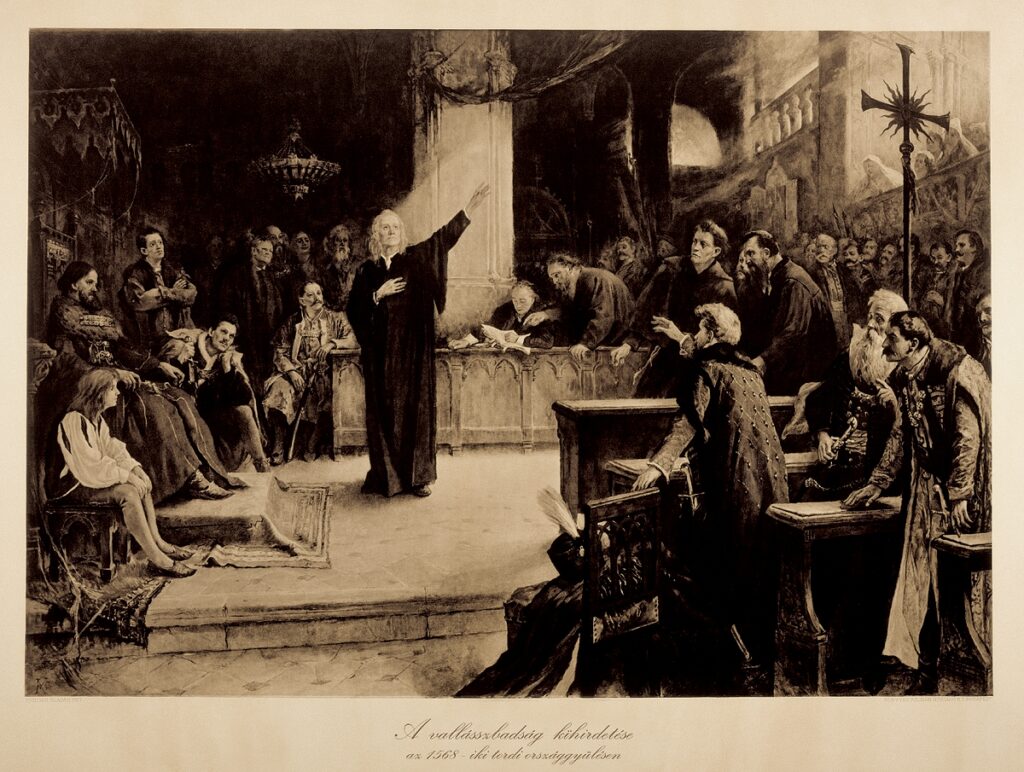
Among the most iconic visual representations of the history of the Hungarian Unitarian Church is Aladár Körösfői-Kriesch’s monumental painting Ferenc Dávid Addressing the Diet of Torda (1568). The work depicts one of the defining moments in the history of Transylvania: the Diet of Torda, where the principles of religious tolerance and freedom of conscience were proclaimed in January 1568. Today, the painting remains one of the most powerful artistic symbols of the Unitarian tradition and the Transylvanian legacy of religious freedom.
The Painting
The painting was completed in 1896 and was commissioned by the town of Torda (Turda) as part of the celebrations marking the millennium of the Hungarian state. During the preparations for the millennium, Hungarian towns and counties were encouraged to commemorate important events from their local history through works of art. The citizens of Torda chose to memorialize the historic Diet of 1568 and entrusted the commission to the young painter Aladár Körösfői-Kriesch.
Measuring approximately three by four meters and covering nearly twelve square meters, the monumental work was first exhibited in Budapest during the Millennium Exhibition, where it received considerable public and critical acclaim. When the canvas arrived in Torda in 1898, it was initially placed in the assembly hall of the town hall. According to local accounts recorded by the writer Domokos Gyallay, the painting was kept behind a curtain for several years to protect it from the heavy pipe smoke that filled the council chamber during meetings.
The Historical Scene
The composition centers on Ferenc Dávid (Francis David), founder of the Unitarian Church in Transylvania and one of the leading figures of the Reformation in the region. Standing before Prince John Sigismund and the assembled estates of Transylvania, Dávid appears illuminated by light streaming through a window. With one hand placed upon his chest and the other raised toward the light, he proclaims the principles of faith and freedom that would become inseparable from the history of Transylvanian Unitarianism.
The dramatic use of light emphasizes both the spiritual and historical significance of the moment. Although the painting was created more than three centuries after the event itself, it has profoundly influenced how later generations have imagined the Diet of Torda and its participants.
Historians note that while the Diet is often associated today with modern concepts of religious freedom, the decree of 1568 primarily guaranteed the right of local communities to choose their own preachers and prohibited persecution on religious grounds. It recognized four accepted denominations within the Principality of Transylvania—Catholic, Lutheran, Reformed, and Unitarian—while other communities remained outside this legal framework. Nevertheless, in a sixteenth-century Europe marked by religious conflict, the decree represented a remarkable and innovative step toward religious tolerance.
An Inspired Image of Ferenc Dávid
One of the challenges facing Körösfői-Kriesch was that no authenticated contemporary portrait of Ferenc Dávid had survived from the sixteenth century. According to a long-standing tradition preserved within the artist’s family, the painter may have drawn inspiration from the appearance of the elderly Franz Liszt when creating the reformer’s figure.
Whether entirely accurate or not, this tradition reflects the artist’s intention to create a figure of exceptional spiritual authority and historical significance. The resulting image proved highly influential and helped shape the visual representation of Ferenc Dávid for later generations. Many subsequent portraits, illustrations, and monuments drew inspiration from the image established by Körösfői-Kriesch’s painting.
The Artist
Aladár Körösfői-Kriesch (1863–1920) was one of the leading figures of Hungarian Art Nouveau and later became a founder of the influential Gödöllő Artists’ Colony. Throughout his career, he sought to unite art, spirituality, national heritage, and social ideals.
His works often combined historical research with symbolic expression, creating compositions that were both visually compelling and rich in meaning. These qualities are clearly visible in Ferenc Dávid Addressing the Diet of Torda (1568), which stands among the most significant historical paintings of his early career.
Legacy and Location
More than a historical painting, the work has become a visual symbol of the ideals associated with the 1568 Diet of Torda: freedom of conscience, religious tolerance, and respect for human dignity. For many visitors, it provides the most familiar image of Ferenc Dávid and the birth of the Unitarian tradition in Transylvania.
Today, the original painting can be viewed in the permanent collection of the History Museum of Turda. The museum is housed in the historic Princely Palace (Palatul Princiar), a building traditionally associated with sessions of the Transylvanian Diet. The painting remains one of the museum’s most important treasures and one of the best-known artistic representations of the Transylvanian Reformation and the history of religious freedom.