
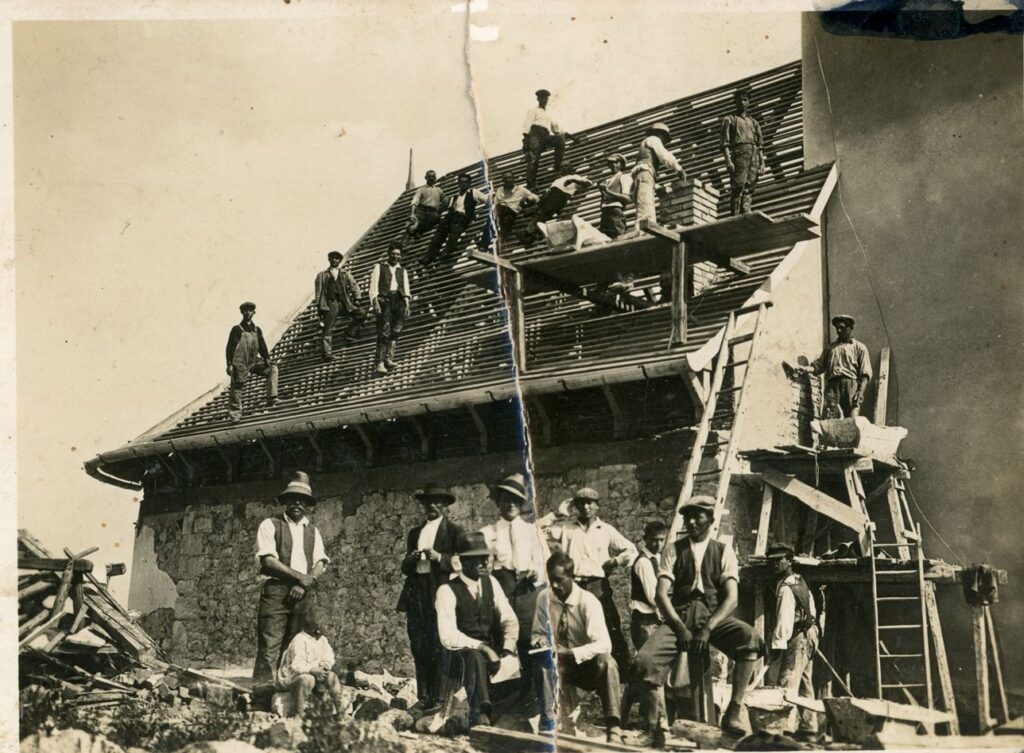
Compiled by: Róbert Zoltán Bálint
“On January 8, 1934, we opened the Torda depot of the Aranyosszék Rural Development Cooperative. One of the display windows was decorated with scattered clay cottages from the villages of Aranyosszék, dusted with plaster like snow. They formed an accurate map of the villages with which we were connected. Next to each village stood a small item of produce: a piece of butter, alabaster, a pot, woven textiles, a sack of flour the size of a wine glass, pastry, wood-turned objects, a small basket—faithfully representing each branch of production. That display window was continuously admired by large crowds until spring. My wife made most of the little houses together with the schoolchildren of Mészkő, and she was also the originator of the idea.”
Ferenc Balázs’s work as an economic organizer is closely linked to his activities in community building and popular education. He did not regard economic organization as an end in itself, but as part of a comprehensive program aimed at strengthening rural communities, in which economic, social, and cultural dimensions form a unity. For him, organizing the economy was a means: the foundation of a way of life that serves human fulfillment and communal culture, and which leads, as a “necessary step,” toward a “more humane, richer, and calmer life.”
Balázs’s activities unfolded in Transylvania in the 1930s, when minority status and the global economic crisis placed Hungarian rural communities in a particularly difficult situation. The economic vulnerability of villages and the uncertainty of markets encouraged him to seek models that strengthened self-sufficiency and community cooperation. His foreign experiences played a significant role in shaping his economic outlook: during study trips to England, the Netherlands, and the United States, he became directly acquainted with cooperative movements. These experiences helped him develop not theoretical but practical, community-based solutions to economic challenges.
At the center of Balázs’s economic organizing work stood the idea of the cooperative, through which he saw the solution to the problems of rural society in community self-organization. He considered the organization of economic life feasible in smaller, cohesive communities, where production, services, and intellectual life function in harmony. His goal was to create a partly self-sufficient, yet open and adaptable system that reduces external economic dependency and serves the well-being of the entire community. In this spirit, he organized various cooperatives—among them for the joint purchase and use of agricultural machinery, a dairy cooperative, consumer and marketing cooperatives, and a credit cooperative—and he also initiated the establishment of the Aranyosszék Rural Development Cooperative. The results of economic activities were consciously reinvested into the community, so that the economy directly supported the strengthening of cultural and communal life.
“The threshing machine purchased on the basis of the farmers’ association no longer meant cooperation for profit. The aim was to thresh their own grain, and after completing the work, the machine was put to rest everywhere. I also founded a dairy cooperative and an animal insurance association.” (Self-sufficiency of Small Societies)
Balázs’s thinking as an economic organizer remains relevant today, in an era when locality, self-sufficiency, and the community economy are being re-evaluated. Small-region development, cooperative models, and sustainable rural development are all directions that can be paralleled with his ideas. The principle he represented—an economy organized from below, based on voluntary cooperation—still offers a viable alternative to globalized and vulnerable economic systems.
Bibliography
- Attila Gábor Hunyadi: Self-sufficiency of Small Communities/Regions, Rural Development According to the Writings of Ferenc Balázs. May 26–27, 2017.
- Ferenc Balázs: Self-sufficiency of Small Societies. Erdélyi Fiatalok, 1932/5. 67–73.
- Ferenc Balázs: Under the Soil, published by the Aranyosszék Rural Development Cooperative, Torda, 1936.
- Imre Mikó, Antal Kicsi, István Sz. Horváth: Ferenc Balázs. Monograph, Bucharest, Kriterion, 1983.
- Ferenc Guzs: “Ferenc Balázs, the Apostle of the Cooperative Movement.” In: József Somai (ed.), From the History of Hungarian Economic Thought in Transylvania. Hungarian Economists’ Society of Romania, Cluj-Napoca, 2001. 237–244.