Compiled by Júlia Koppándi
One of the most defining stories of Ferenc Balázs’s private life was his love and marriage to the American-born Christine Frederiksen. In their relationship, two young people from vastly different cultural worlds found one another: a Transylvanian Unitarian theologian and an intellectual woman born in Chicago to a Danish-English immigrant family. Their love represented not only a personal emotional bond but also the foundation of a shared ideological program: the idea of social justice, community work, and the renewal of rural life.
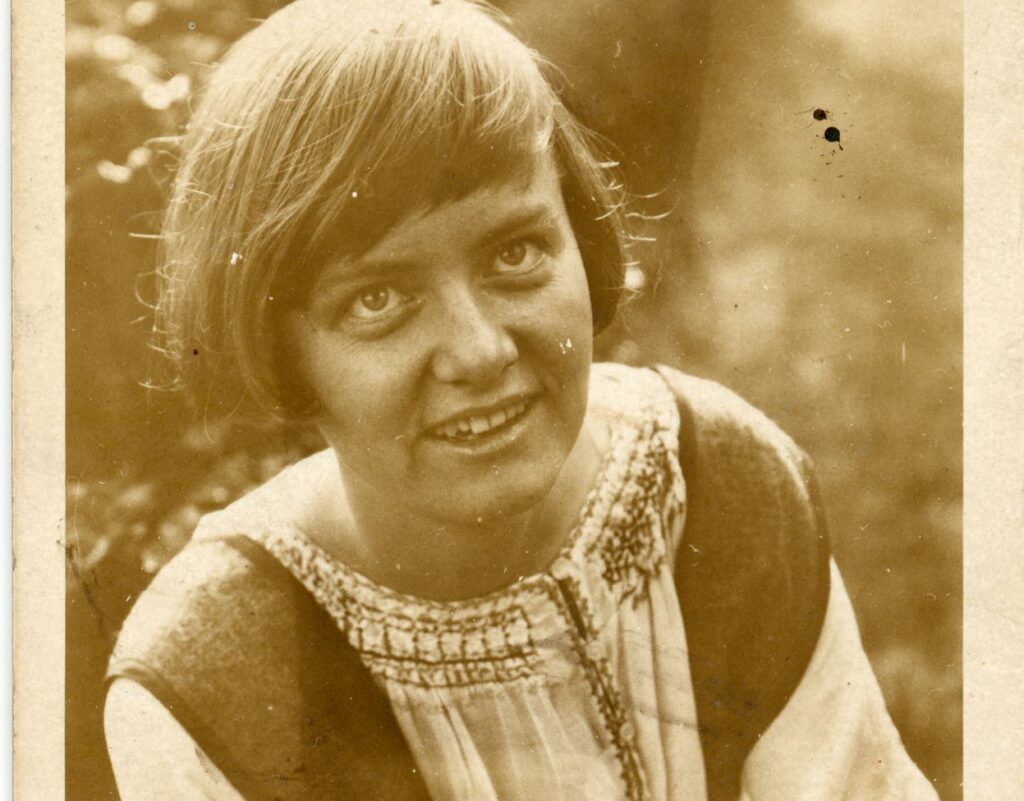
Christine Frederiksen was born in 1903 in Chicago to a Danish father and an English mother. In the late 1920s, she met Ferenc Balázs in the academic circles of Berkeley, California, where he was studying on a scholarship. The young American woman was deeply interested in social issues, and she was profoundly impressed by Ferenc Balázs’s plans for village development and community concepts. The connection between them deepened rapidly.
“I had to realize how few girls among my acquaintances could draw me to them with a magnetic love… now, having found in you the one I was looking for, the desire has grown great within me to take you with me to the other side of the world… I love you, and nothing will change that.” (We Hitched Our Wagon to a Star)
However, the couple’s relationship was put to a serious test by Ferenc Balázs’s decision to return to Transylvania. For Christine, the world of Eastern Europe seemed foreign and uncertain, yet she took the risk. In January 1929, she arrived in Kolozsvár (Cluj) to follow her fiancé. By then, Ferenc Balázs was already struggling with illness, so Christine followed him first to Homoródújfalu and then to Székelykeresztúr.
“It is true, we had no wedding rings. We had no rings of any kind, no nose rings, ankle rings, earrings, or necklaces. […] From then on, we carefully slid them onto our fingers whenever we went for a walk or a visit. Upon arriving home, we hung them with similar care on two small nails driven into the wall.” (Beneath the Clod)
In 1930, they moved to Mészkő, near Torda (Turda), where they were also married:
“The rejoicing faithful filled the church to capacity. There was no room left for anyone but the flies, which buzzed merrily on the window panes. The neighboring village priest described the story of our great love with eloquent words. The bride had come from the other end of the world to be the faithful life partner of her faithful companion. Love is indeed a great thing. The bride, poor thing, was thinking of her homeland across the sea, of the relatives and good acquaintances from whom this marriage vow might now separate her forever. Her tears overflowed. […] We loved our lives. We arrived in Mészkő as if in a dreamland. […] Perhaps we have never been so happy since.” (Beneath the Clod)
Ferenc Balázs worked on the economic and spiritual renewal of the village, and Christine actively assisted him: she established a “Children’s House” in the parsonage, sourced chalk and picture books, and gave lectures to the village women on health and hygiene. Although the American woman often felt like a stranger in the Transylvanian rural environment, she strove to adapt and participate in her husband’s mission.
“I cannot decide whether Feri is a saint, an angel, or a little boy. Whichever of these he may be, he needs someone to take care of him, for he is far too busy to have time even to buy himself a new toothbrush, shoes, or socks.” (Mészkő)
However, their shared life also brought many hardships. The rural conditions, poverty, and Ferenc Balázs’s deteriorating health placed a heavy burden on the family.
“The woman arriving from America feels herself outside of civilization throughout her time in Transylvania, exposed to unaccustomed rural, peasant conditions. She looks with estrangement at the women scrubbing laundry in the Aranyos river, plastering the floors of their houses, or patterning the walls with large flowers. She is alienated by the heavy, decorated women’s costumes, the heavy, ornate furniture, and the hairstyles of the men. She is surprised by the superstitions surrounding childbirth, infant care, and animal husbandry. She fights bitterly against the invasion of flies, just as she struggles for the observance of basic hygienic rules regarding washing, animal keeping, eating, and the use of the home. In this endeavor, she remains alone. The village is not prepared for change, and Ferenc Balázs is unable to fulfill the demands set by Christine.” (Vilmos Keszeg: Two New Source Publications on Ferenc Balázs)
Christine often worried about her husband’s excessive pace of work. In the autumn of 1931, she went to Denmark, where their daughter, Enikő, was born. She returned to Mészkő in December 1932, and then traveled to Denmark again with her child in 1935.
Nevertheless, Christine remained devoted to her husband until the end and returned to him when his condition worsened. In the autumn of 1936, she sent their young daughter to relatives in California and traveled to Mészkő to be by her dying husband’s side. Ferenc Balázs passed away in 1937, at the age of only thirty-six. His wife later remembered him thus:
“Feri’s life was beautiful, it just ended too soon, because his will and imagination were too strong, and his activity too intense for his fragile body.” (Mészkő)
The story of Ferenc Balázs and Christine Frederiksen is not merely a chronicle of a romantic relationship, but a story of two people’s shared ideals and sacrifices. Their love was fulfilled despite geographical and cultural distances, and in their marriage, personal emotion and the ideal of community service were tightly interwoven. Without Christine’s support, work, and perseverance, the village development experiment in Mészkő could not have been realized in the form in which we remember it today.
Bibliography:
- Mészkő (Alabástromfalu). Ferenc Balázs’s wife on the years spent in Transylvania. 1930–1937. Author: Christine Frederiksen. Translated by József Kászoni. Budapest, 2002.
- „Csillaghoz kötöttük szekerünk.” (We Hitched Our Wagon to a Star) Letters from Ferenc Balázs to Christine Frederiksen. Edited and preface by Júlia Vallasek. Cluj-Napoca, 2002.
- Vilmos Keszeg: Két új forráskiadvány Balázs Ferencről (Two New Source Publications on Ferenc Balázs). In: Erdélyi Múzeum, 2007/69.